Paywalls hit 10.7% conversion · Meta and TikTok block each other's ads
|
The Mobile Takeaway
For people who ship apps
|
Wednesday, October 14, 2026
|
RevenueCat data shows hard paywalls convert at a 10.7% median rate compared to 2.1% for freemium models.
Google Play is adding AI app comparisons and lower service fees for high-quality apps, while Apple updated its terms to support group subscriptions.
Platform
| • | Google Play adds AI app comparisons and service fee rewards Android Developers Blog Ask Play now generates side-by-side app comparisons including subscription models, while updated Google Play quality programs offer lower service fees for high-quality user experiences. |
| • | Apple updates developer agreement with group subscriptions and tax reporting Apple Developer News The revised terms introduce subscription group purchases and volume sales for organizations, while clarifying that Apple reports developer tax, sales, and contact data to authorities. |
| • | Apple HomeView requires CarPlay apps for video and subscription services AppleInsider The HomeView interface lacks native support for video and subscription apps, meaning developers must provide CarPlay-compatible versions to run without an iPhone. |
| • | Gemini 4 Argon brings autonomous build self-correction to Android Studio Android Developers Blog The new model fixes local build failures by iteratively diagnosing Gradle and Kotlin compiler logs within the Antigravity harness in Android Studio Canary. |
Monetization
 | ▶ YouTube · 10 min Sub Club by RevenueCat The case for (and against) hard paywalls |
Key takeaway: Hard paywalls convert five times better than freemium models without hurting long-term retention, but the right choice depends on your cost to serve and whether free users act as a marketing engine.
• RevenueCat data shows a 10.7% median conversion for hard paywalls compared to 2.1% for freemium, while year-one retention remains nearly identical at 27-28%.
• BoldVoice CEO Anada Lakra argues that charging early filters for your ideal customer profile, preventing product teams from being distracted by feedback from users who will never pay.
• Screen time app Opal reached $10M ARR after switching from a hard paywall to freemium; although the paying share of users dropped from 20% to 9%, total revenue and DAUs grew tenfold as free users became a marketing channel.
• Removing the dismiss button to force trials often backfires; BoldVoice found that while trial starts increased, a subsequent spike in refunds made the move net-negative.
• Natal founder Nancy Anderson removed free trials from monthly plans and saw a 2,000% increase in subscriptions, suggesting that high-trust onboarding can replace the need for a trial period.
• Weather Up moved to a hard paywall because the cost to serve—paying for weather data for every user—exceeded the revenue generated by banner ads.
• Fitness app Ladder uses a reverse trial with no credit card required, focusing 90% of effort on product activation to let the workouts sell the subscription.
Why it matters: Founders must decide if they are playing checkers with a reliable hard paywall or chess with a complex freemium model that requires significant scale to offset lower conversion rates.
Worth it: Yes, because it provides concrete benchmarks for conversion and warns against mechanical paywall tricks that look good in trials but fail on net revenue.
themobiletakeaway.com
 | ▶ YouTube · 7 min App Masters How Cal AI Scaled Influencer Marketing Without Killing Views |
Key takeaway: Cal AI scaled by letting influencers use their native content formats and placing app integrations at the 20-30 second mark to preserve viral potential.
• Jake Castillo warns that forcing influencers into "infomercial" styles often drops views from a 1 million average to 50,000, leaving brands "thousands of dollars in the red."
• The team treats established influencers as "artists" who know their audience better than the brand does, providing only minimal guidelines on how to show the app.
• Cal AI found through testing that placing the product integration between 20 and 30 seconds was early enough for exposure but late enough to avoid triggering "ad-blindness."
• The strategy distinguishes between UGC and influencer marketing: UGC accounts should use proven viral formats, while influencers should stay within their established style.
• Castillo notes that a friend's app found its sweet spot at the 60-second mark, illustrating that founders must test their own timing rather than copying Cal AI's numbers.
• The co-founding team, including members aged 17 and 18, maintained a high risk tolerance to find asymmetric payouts through big bets.
• Influencers reported Cal AI was their "easiest brand deal" because they were given full creative control over the narrative.
Why it matters: For founders scaling via social, micromanaging creative usually destroys the reach you paid for; testing the specific second an ad appears is the lever that preserves ROI.
Worth it: Yes, because it provides a specific, contrarian tactic for influencer management and a concrete testing variable.
themobiletakeaway.com
| • | Meta and TikTok mutually block each other’s advertisements Mobile Dev Memo Meta banned ByteDance ads and TikTok links over a child-safety dispute, impacting creator campaigns and risking retaliation against Meta’s own promotional efforts for Muse. |
Business
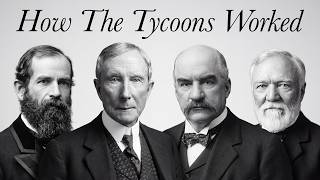 | ▶ YouTube · 54 min Founders Podcast The Tycoons: Carnegie, Rockefeller, Gould & Morgan |
Key takeaway: The founders of the American super-economy built dominance by aggressively cutting costs, removing operational bottlenecks with brutal speed, and turning infrastructure into a platform for mass consumption.
• Andrew Carnegie pivoted his entire business to steel in 1872 after seeing a single factory in England, betting that the shift from iron to steel was the defining opportunity of his era.
• Carnegie’s operational mantra was to "cut costs, take share, gain scale," believing that if costs were managed with fanatical detail, profits would take care of themselves.
• John D. Rockefeller achieved a "money printing machine" by outbidding partners for a $72,000 refinery that generated $1.2 million in sales the following year.
• To force acquisitions, Rockefeller would open his books to competitors; if they refused to sell, he unleashed "total blazing warfare" across pricing, supply, and transport until they capitulated.
• Jay Gould used financial leverage to find points of advantage in complex structures, once cornering the cattle market to ship his own livestock at a loss-making rate set by a rival railroad.
• The infrastructure these tycoons built—railroads, telegraphs, and steel—acted as a platform that allowed companies like Procter & Gamble to turn accidental inventions into national consumer brands.
• Rockefeller maintained secret ownership of acquired companies, keeping original names and management to mask his market roll-up and maintain a competitive advantage.
• J.P. Morgan acted as a "regulator" who suppressed what he called "ruinous competition," believing that order and debt repayment were more valuable than the creative destruction of his peers.
Why it matters: Understanding how these founders used speed, cost control, and platform-building to dominate their markets provides a blueprint for app founders navigating today's platform shifts.
Worth it: Yes, because it illustrates how ruthless focus on unit economics and infrastructure can turn a commodity into a monopoly.
themobiletakeaway.com

The next issue, in your inbox.
Apple and Google updates, pricing and paywalls, and the numbers behind app businesses. Get the brief every weekday morning.
Free. Every weekday. Unsubscribe anytime.