|
The Mobile Takeaway
For people who ship apps
|
Monday, October 19, 2026
|
Apple's flagging peptide apps for dosage calculators and updating guidelines to ban hidden features, which developers say could target remote paywall flags.
Adam Lyttle reports the store's also begun terminating accounts for shipping frequent, low-effort clones. Engineer Rasty Turek is making $3,000 a day with an AI-built vault app that uses automated web SEO to bypass traditional ASO.
Platform
| • | Apple re-reviews live peptide apps over dosage calculators @thatdadjacob on X (screenshot of Apple message, plus replies)
Peptide app developers are getting Apple notices that their live apps break Guideline 1.4.2 (Safety - Physical Harm) by calculating peptide dosage or reconstitution, including mentions in metadata. Apple says such features must come from the medication manufacturer or a recognized institution. Many devs report the same notice; some are stripping calculators, others pulling their apps. |
| • | App Store keyword rankings are shifting across countries @gorniv on X (4 screenshots, ASO.dev dashboards)
Igor Kravchenko (@gorniv) reports "massive shifts in keyword rankings and the number of indexed keywords across multiple countries," though his team barely touched its keywords after a Sept 30 cleanup. He dates the change to Oct 8 in the US and Oct 14 elsewhere; other devs see the same. If your rankings moved, it may not be your metadata. |
| • | Is it worth running App Events? @phlpcrlsn Philip Carlson says App Events are a brand defense tool. Since existing users don't see screenshots in search, events fill that space. For big brands, he recommends an "always-on" strategy. Smaller apps can stick to special occasions. While events convert lower than screenshots for new users, they add color to product pages and help with featuring nominations or appearing as personalized recommendations.
 | Philip Carlson ✓ @phlpcrlsn | 𝕏 |
glad you asked it's very interesting actually...
1. in general events convert lower than screenshots, but for existing users there are no screenshots, so a primary goal is to run events to make up for that/show events instead
2. there are specifics to when events show in search (as you mention they sometimes show for apps you don't have too), here's the breakdown:
- existing user: event always shows
- lapsed user (delated app): usually shows, especially Major Update events
- new user: event rarely shows in search results (but more so lately)
3.…
|
| • | PayPal and Epic fear a weak Apple-DOJ antitrust settlement 9to5Mac
The Information reports PayPal and Epic Games are among developers worried a potential Apple-DOJ antitrust settlement won't go far enough. |
| • | Apple updates App Review Guidelines for external links and creative assets Apple Developer News
Apple merged music streaming rules into external purchase link entitlements and added a new guideline for creative assets while formalizing the ban on hidden features. |
Monetization
| • | Apple's new guideline 2.5.19 has devs rethinking remote paywall flags @adamlyttleapps and @MarioSaputra on X; Apple Developer News, Oct 16
Apple's Oct 16 update adds 2.5.19: "Don’t include any hidden, dormant, or undocumented features in your app; your app’s functionality should be clear to end users and App Review." Apple calls it a clarification of long-standing policy. Adam Lyttle reads it as targeting remote paywall flags; others say A/B tests on reviewed paywalls look fine. The safe play: ship every variant in the build. |
Business
 | ▶ YouTube · 14 min Adam Lyttle |
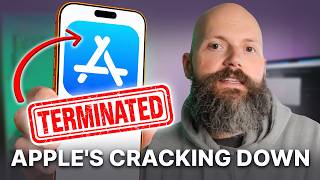
Key takeaway: Adam Lyttle says Apple is terminating developer accounts that ship frequent, low-effort apps or near-identical niche clones, the "machine gun" strategy.
• Developers report terminations and two-month waits for a human reply; one puts the chance of recovery at about 1%.
• Lyttle says every new submission puts your whole portfolio under review; one "sloppy" or "spammy" app can put the account at risk.
• Shipping one app a week is no longer viable, he argues, as Apple weighs quality and review costs over store volume.
• Apple flagged Dan Kulkov's language-learning apps (Learn Japanese, Learn Spanish and so on) as "duplicate apps" because they were too similar.
• Kulkov saved his account only after posting about it to his 51,000 X followers; three messages to Apple had gone unanswered.
• A cloner who submitted 50 copies of indie apps in one week got a termination notice.
• Building in public is now a defensive tactic to show you're a "real person," not a faceless spam operation.
Why it matters: Your legacy portfolio can be a liability; one spammy app can cost you the whole account.
Worth it: Yes, because it outlines a shift from "shipping more" to "cleaning up" to avoid total account loss.
themobiletakeaway.com
 | ▶ YouTube · 15 min Starter Story |
Key takeaway: Former Google engineer Rasty Turek built an encrypted iOS vault app that makes up to $3,000 daily using an entirely AI-generated codebase and an automated SEO pipeline.
• Turek built the first version of Vaultaire in three weeks without writing a single line of code, instead using Claude and OpenAI Codex agents for both the app and the marketing site.
• The app generates $2,000 to $3,000 in daily revenue, with lifetime purchases priced at $39.99 accounting for over 80% of total earnings.
• Growth comes from SEO: agents using his open-source Gum tool find gaps in Google Keyword Planner and publish 1-2 guides a day for searches the App Store ignores.
• Conversion to paid users increases over time, rising from 5.47% on the first day to 8.62% by day 35 as users see the app's value.
• The architecture uses pattern-based access and on-device encryption with no external servers, meaning neither the founder nor Apple can access user data.
• The app reached $41,000 in monthly revenue just six months after launch, starting from a first-month total of only $66.
• Turek focuses on web-to-app conversion, which sits at approximately 10%, because legacy competitors with millions of reviews make ranking via traditional ASO nearly impossible.
Why it matters: It shows a solo founder can enter a saturated, 15-year-old app category and win by using AI agents to automate both engineering and web-based customer acquisition.
Worth it: Yes, because the specific tactics for automated SEO and the shift toward lifetime-heavy revenue provide a repeatable blueprint for utility apps.
themobiletakeaway.com
 | ▶ YouTube · 80 min David Senra |
Key takeaway: Kurt MacAlpine scaled Corient to $525 billion in assets by replacing the traditional "independent contractor" wealth management model with a single global P&L and a unified compensation plan for all 3,000 employees.
• Corient operates as a fee-only fiduciary across 15 jurisdictions, managing $525 billion for ultra-high-net-worth clients while avoiding the internal conflicts typical of large banks.
• The firm uses a single global P&L with no internal chargebacks, allowing any advisor to bring in specialized tax or aviation experts without impacting their specific team's budget.
• MacAlpine implemented a "one compensation plan" policy for all 3,000 staff members to ensure every employee is incentivized by the same firm-wide financial outcomes.
• For its ~50 acquisitions, Corient requires total "Day 1" integration where the acquired firm immediately moves to the parent brand, technology stack, and benefits package.
• The company maintains a median partner age in the mid-40s, significantly younger than the industry average of early 60s, to focus on a 20-year runway for compounding.
• While public, MacAlpine used free cash flow to aggressively buy back shares at $12 to $13, arguing that public markets often fail to understand or value long-term business transformations.
• After going private in August 2025, the firm focused on growth acceleration rather than cost-cutting, announcing deals for the two largest UHNW managers in Europe.
• Corient utilizes a "repetition strategy" for marketing, sponsoring entire live broadcast programs to ensure the brand is seen multiple times by a specific target audience.
Why it matters: Founders can apply Corient’s "clean slate" approach to incentive design to prevent the internal silos and "advisor-to-back-office" friction that typically break a service or app business as it scales.
Worth it: Yes, because the breakdown of why public markets struggle to value transformation stories is a vital lesson for any founder weighing an IPO against private growth.
themobiletakeaway.com