Apple opens Siri AI to all apps · how Bria Sullivan got 23M downloads
|
The Mobile Takeaway
For people who ship apps
|
Wednesday, November 4, 2026
|
Apple opened Siri AI to all apps in the latest betas while ChatGPT search volume hit a fifth of Google's.
Bria Sullivan used a feedback loop to reach 23 million organic downloads, and RevenueCat's paywall roast notes that about 80% of revenue typically comes from the onboarding paywall.
Platform
| • | Apple opens Siri AI to all developers in latest betas Apple Developer News The iOS 27.3 beta lets any app integrate Siri AI via App Intents, enabling onscreen awareness, personal context understanding, and multi-step skills for custom actions. |
| • | Apple adds GitHub Copilot support to Xcode 27.3 beta assistant 9to5Mac Apple's Xcode 27.3 beta 1 expands the native coding assistant to support GitHub Copilot, letting developers use the third-party AI tool directly within the IDE. |
| • | OpenAI says ChatGPT search volume has reached 20% of Google's 9to5Google OpenAI says ChatGPT's search use has grown to roughly 20% of Google Search's total volume. |
Monetization
 | ▶ YouTube · 81 min RevenueCat (YouTube) |
Key takeaway: Put a paywall in onboarding, where about 80% of revenue typically comes from, and keep testing trial lengths and placement.
• Headspace saw a double-digit conversion increase by testing a 14-day free trial for annual plans against a 7-day trial for monthly plans.
• RevenueCat experts estimate that approximately 80% of total revenue typically originates from the paywall presented during the initial onboarding flow.
• A "Try for $0" button is a high-performing trend that lifts initial clicks, but watch cancellations and churn closely.
• Calm uses a "Trial Reminder" toggle on the paywall to bridge into a notification permission request; users who opt-in for a reminder are significantly more likely to grant system permissions.
• Julie's contrarian hack for MyFitnessPal: drop the 7-day trial from the monthly plan and keep it on the yearly one to push annual subscriptions.
• Duolingo uses a multi-step paywall that includes a comparison table and a specific screen for users to choose when they want a trial expiration reminder.
• Cal AI sends at least four meal reminders a day; Luigi flagged repetitive copy and poor localization, like noon lunch reminders for a user in Spain who eats at 2pm.
• Flagged mistakes: Cal AI asks for an App Store review during onboarding, and FaceApp asks for photo access without any context.
Why it matters: These specific UI patterns and timing tweaks directly impact trial-to-paid conversion rates and long-term retention for subscription-based apps.
Worth it: Yes, because it provides a direct look at the high-conviction tactics used by market leaders like Duolingo and Headspace to optimize their funnels.
themobiletakeaway.com
 | ▶ YouTube · 58 min RevenueCat (YouTube) |
Key takeaway: Bria Sullivan achieved 23 million organic downloads by replacing traditional marketing with a three-step feedback loop that forces developers to abandon their original vision in favor of what a specific Ideal Customer Profile actually wants to see and share.
• Sullivan applies a one-second rule where a user must understand the app's purpose and utility immediately upon seeing the App Store listing or they will not download it.
• The playbook uses short screening surveys to find high-quality interview candidates, specifically filtering out anyone who does not already use mobile apps to solve problems.
• During interviews, Sullivan avoids showing mockups initially to let users describe their own baseline expectations, only later presenting a grid of six distinct art styles to see which one earns the click.
• For the game Boba Story, this process led Sullivan to pivot from a standard cat-themed aesthetic to a silly hand-drawn frog style, lifting TikTok views from tens of thousands to over 500,000 on top videos.
• Focus Friend grew from 2 million to 5 million downloads entirely through word-of-mouth after Hank Green's final promo, proving the feedback-driven design created a self-sustaining growth engine.
• She recommends at least 10 interviews (she did 25 for Focus Friend) to spot patterns like ADHD-friendly design or privacy concerns that reviews alone often miss.
• To find viral features, Sullivan explicitly asks interviewees what specific part of the app they would be willing to share to their Instagram story.
• Monetization and conversion experiments are run in smaller geographic markets or limited to 10% of the audience to avoid alienating the core user base.
Why it matters: This framework provides a repeatable method for solo developers and small teams to build products with high shareability and organic discovery, reducing reliance on paid acquisition or constant social media posting.
Worth it: Yes, because it offers a concrete, low-cost alternative to expensive user acquisition by treating aesthetic and feature decisions as data-driven experiments rather than founder intuition.
themobiletakeaway.com
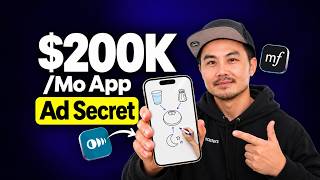 | ▶ YouTube · 10 min App Masters |
Key takeaway: Steve Young of App Masters demonstrated a workflow to replicate high-performing whiteboard ads from Shotsy—an app earning $200,000 monthly—using AI tools to bypass traditional production costs and timelines.
• Shotsy generates approximately $202,083 in monthly revenue with a monthly ARPU of $0.64, largely driven by hand-drawn whiteboard explainer ads.
• The traditional production of these ads requires hiring an illustrator, animator, and voice actor, often costing thousands of dollars and taking weeks to complete.
• Using the Maxfusion MCP within Claude, founders can use a Radar tool to extract the hook, body, and call-to-action from a competitor’s top-performing ads.
• A content analyzer tool deconstructs video files to provide a second-by-second transcript and visual breakdown of what is drawn on screen.
• The Seedance 2.5 model generates animated whiteboard scenes from a script for roughly 250 credits per clip, allowing for rapid iteration at a lower resolution.
• Automated voiceovers and word-by-word highlighted captions are added via integrated AI skills to match the visual timing.
• The entire workflow can be saved as a reusable Skill within the AI interface to generate new ad variants for different apps or topics instantly.
Why it matters: Small teams can now test high-converting ad formats like whiteboard explainers without the overhead of hiring specialized creative talent.
Worth it: Yes, it provides a concrete, repeatable tactic for reducing user acquisition costs through AI-assisted creative production.
themobiletakeaway.com
| • | AdMob hits $3.1B, ending Alphabet's 17-quarter network slump Mobile Dev Memo AdMob made an estimated $3.1 billion in Q3, up 5.9% year over year, ending a 17-quarter decline for Alphabet's Network segment. |

The next issue, in your inbox.
Apple and Google updates, pricing and paywalls, and the numbers behind app businesses. Get the brief every weekday morning.
Free. Every weekday. Unsubscribe anytime.